Myers & company


The brain is made up of lobes. The lobes perform different functions.
Here's a summary of the basic functions performed by each lobe.
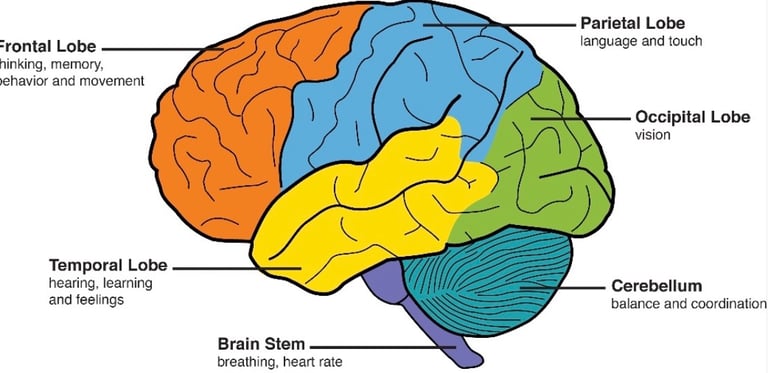
It seems like the Occipital Lobe is solely responsible for vision. I mean, that's what it says.
And, after all, the summary for the Frontal Lobe doesn’t say anything about vision. (It says “movement” but it doesn’t say “eye movement.”)
So, until recently I thought raw data was—with a few detours or stops along the way—routed from the eyes to the Occipital Lobe, and that was the whole visual system.
It seemed to make sense when you looked at the “wiring diagram” of the optic nerves and radiations.
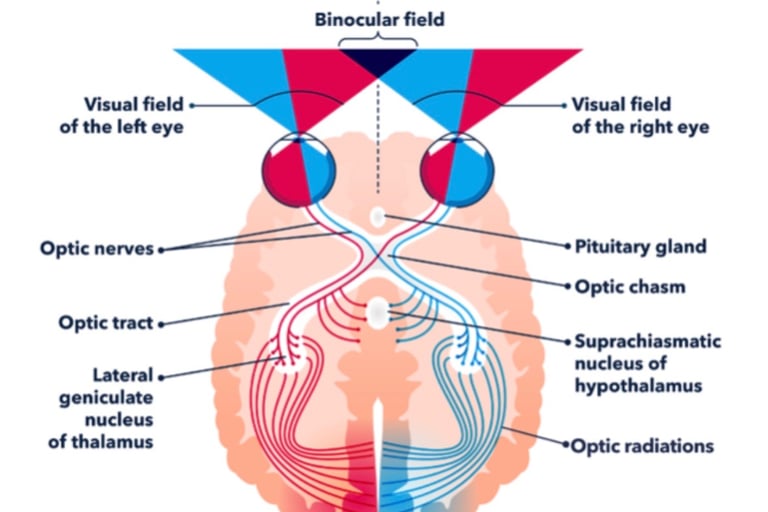
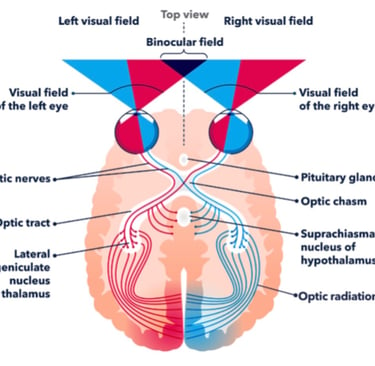
But there's a lot more to it.
The visual system has quite a few "parts" and processes. It isn’t just the eye “seeing” and the Occipital Lobe processing raw data.
A key part of the visual system is the way the eye obtains that raw data. I’m not going to go into detail about all the components. But I am going to discuss one of them because it's frequently implicated in mTBI cases.
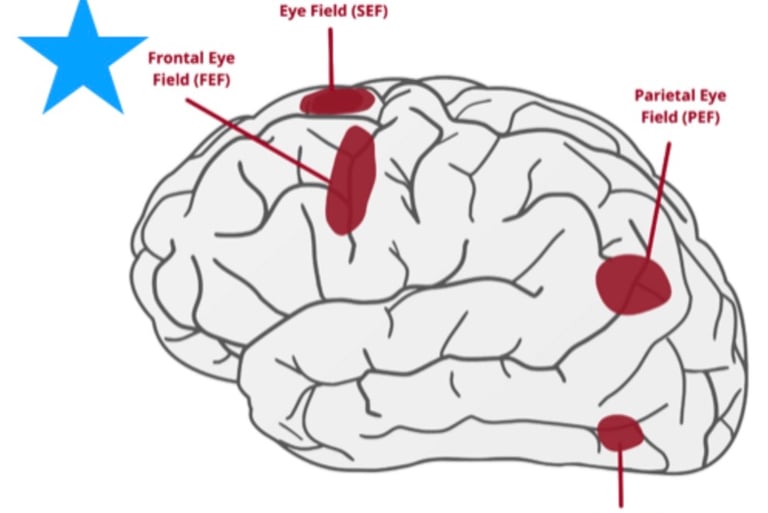
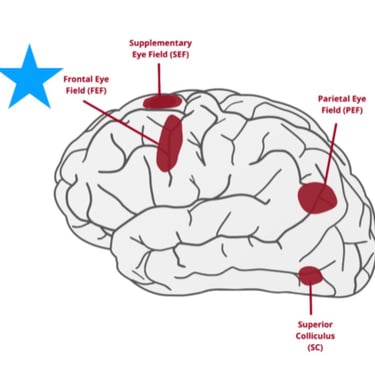
The part I'm talking about facilitates data acquisition and voluntary eye movements. One of these parts is called the Frontal Eye Field (FEF). It's located within the Frontal Lobe. It plays a crucial role in controlling voluntary eye movements. This diagram shows where the FEF (and other Eye Fields) are located.
Saccades are an important voluntary eye movement. Here’s a definition/explanation of saccade:
A saccade is a rapid, jerky eye movement that shifts your gaze from one point of interest to another. It brings new images to the retina for detailed processing. These jerky eye movements alternate with brief periods of stable vision called fixations. Together, saccades and fixations create a "scan path" for how we explore a scene. Saccades can be voluntary (like reading) or involuntary (like reacting to a flash) and are crucial for efficient visual exploration. Vision is suppressed during the movement itself (saccadic masking) to prevent blur.
The saccadic eye movement we use for reading originates in the FEF.
Here’s an example of how saccades are supposed to work.
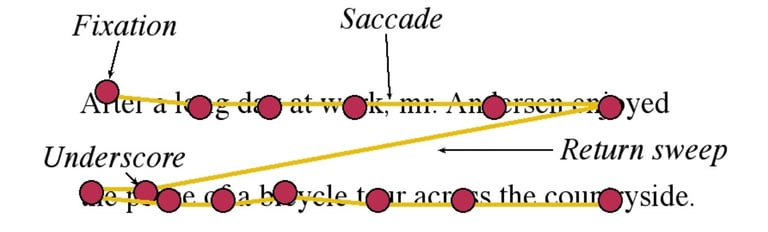
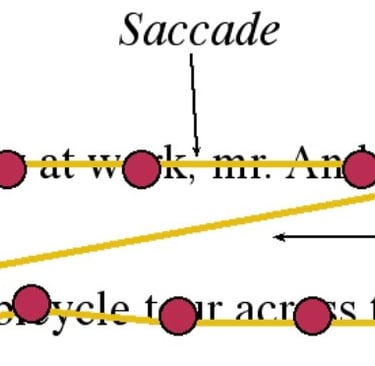
Injury to the FEF (or its connections to the other parts of the brain) disrupts the saccades needed for reading. An injury to the FEF causes difficulty shifting between lines of text. It (injury) produces slower reading speeds, more word errors (identifying the wrong word), and decreased comprehension.
This is an example of what eye movements look like after saccades are affected by an mTBI.
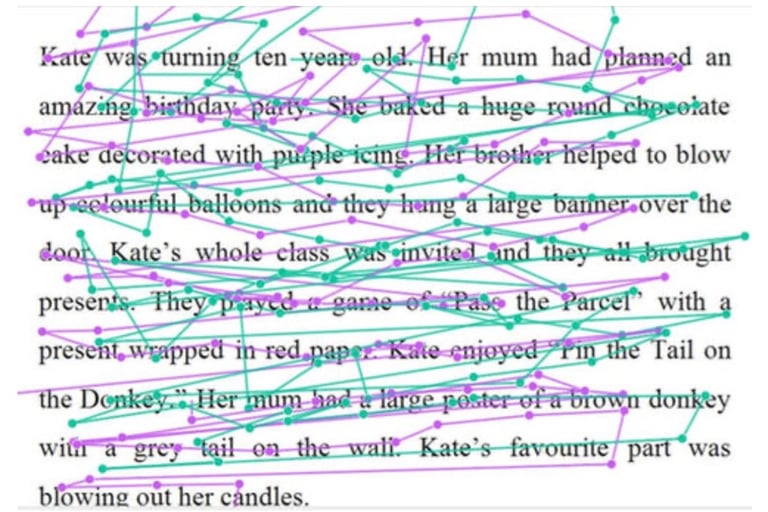
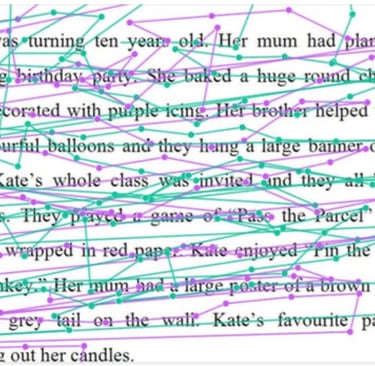
Mild traumatic brain injuries (definitionally) don’t show up in imaging. But there’s strong objective evidence (e.g., testing that follows the eyes during reading) that establishes or corroborates the nature of the brain injury.
As some say, the eyes (or the ayes) have it.
Myers & Company
Personal Injury Attorneys
© 2024. All rights reserved.