Myers & company
I was reading about the Pacific Palisades fire.
Some guy set a small fire.
It was discovered and put out. Or so people thought. Actually, it was still smoldering underground.
Because of the drought (and high winds) it re-ignited and burned down all those houses in Pacific Palisades.
Setting a fire is a little bit like causing a concussion. The fire may start small. But depending on where and when it’s set, it can cause massive impact.
Same thing with a concussion. A bad concussion may not have a big effect on some people (like setting an intense fire during rainy seasons). And a mild concussion can set in motion a series of events that has a profound effect on someone else (like setting a little fire when everything is really dry or it’s windy out).
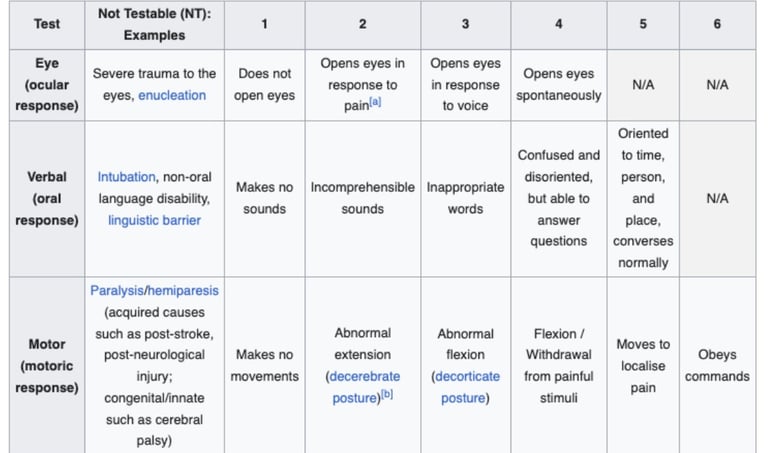
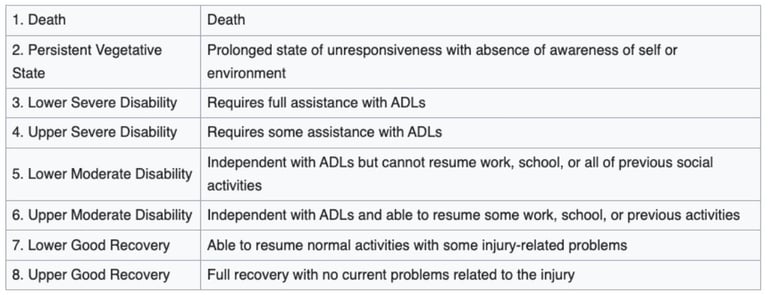
There are two scales that are used to assess people after head injuries. The Glasgow Coma Scale (GCS) measures severity of symptoms right after the impact. The Extended Glasgow Outcome Scale (GOSE) measures how people recover from the head injury.
Here’s what they look like:
Glasgow Coma Scale
Extended Glasgow Outcome Scale (GOSE)
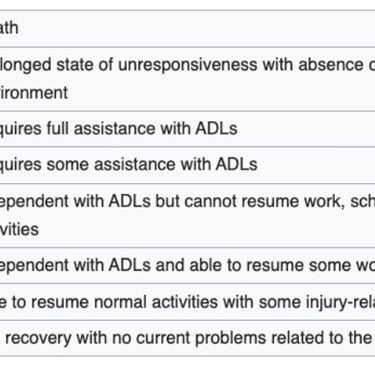
And here’s the big point.
There is no direct connection between the two. There is no guide or algorithm that says if you have a GCS symptoms severity score of X, you’re going to have a GOSE score of Y.
That’s because the severity of the symptoms right after a head injury do not predict the extent of the recovery or disability the injured person will experience.
The same GCS can lead to vastly different GOSE outcomes depending on a variety of factors including age and resilience.
[For the statisticians: Correlation coefficients between initial GCS and later GOS/GOS-E typically fall between r = 0.4–0.6, indicating, at best, a moderate predictive value. Nothing that even begins to approach “reasonable medical certainty.”]
With a GCS of 15 you can have a full recovery. Or a good recovery. Or moderate to severe disability.
Hunter S. Thompson wrote: “Buy the ticket, take the ride.” That’s the part that I remember. But the whole quote is actually worth including here:
No sympathy for the devil; keep that in mind. Buy the ticket, take the ride...and if it occasionally gets a little heavier than what you had in mind, well...maybe chalk it up to forced consciousness expansion: Tune in, freak out, get beaten.
If you set a small fire, you bear the risk of it turning into a very large fire.
Insurance companies need to realize the same thing is true when one of their insureds cause mild concussion: The initial insult to the brain may be small, but depending on the person, it may turn into a life-altering condition.
Myers & Company
Personal Injury Attorneys
© 2024. All rights reserved.